
Release Mugshots as Public Records
A booking photograph records appearance during intake. Idaho Code §20-601 requires the sheriff or jailer to photograph a person received into custody for a felony, and it permits photos in other cases. The image belongs to the arrest and booking process. It does not show whether a charge later was dismissed, whether guilt was found, or whether the person is free now.
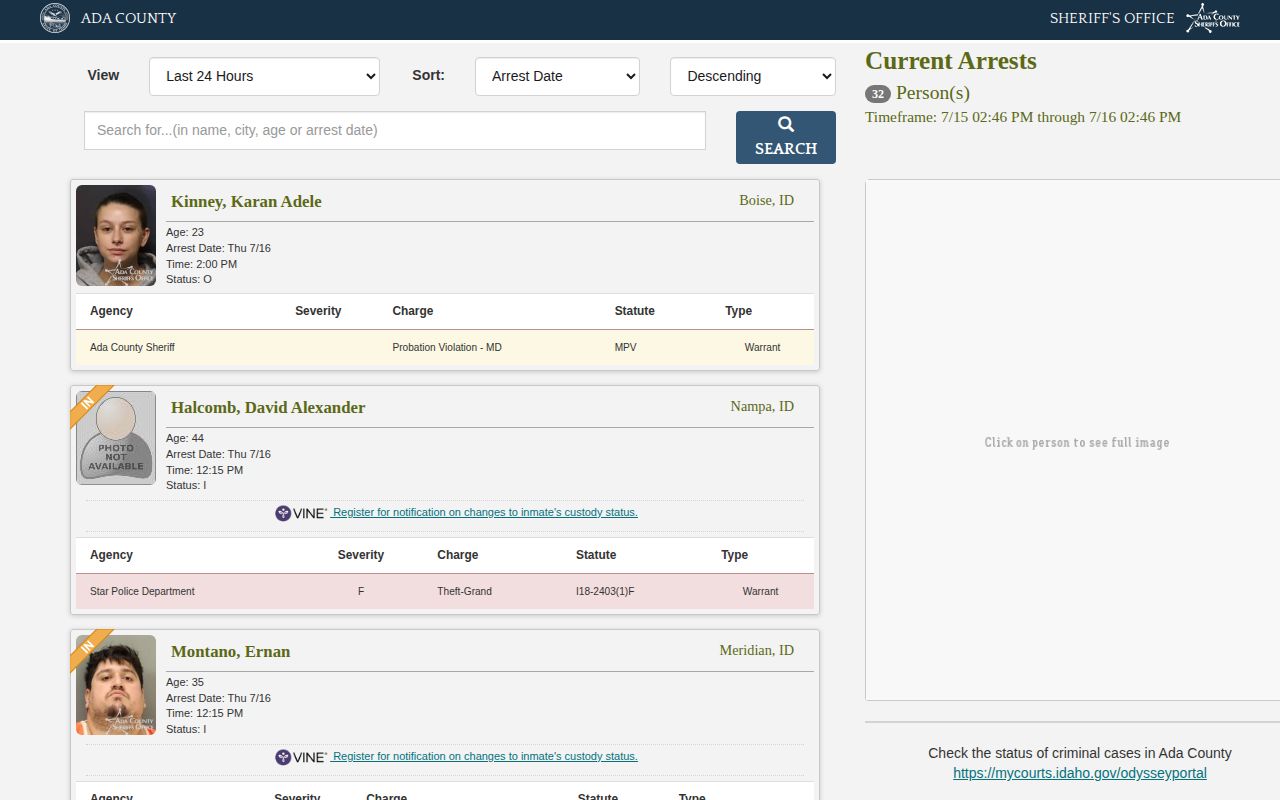
Ada County's online access is short-lived. The sheriff's Current Arrests service can display a photo with recent arrest facts, including records observed with an O status. Yet the selectable clock runs from arrest time and stops at five days. A released person may therefore have a visible image for part of that period, while an older photo ordinarily requires a records request. Public creation of a photograph does not guarantee permanent online display or disclosure in every case.
Match the full name, date of birth, arrest date, agency, booking identifier, and court case where possible. A similar face is supporting evidence, not a conclusive identity method. The photo must be read with the record that explains when and why it was made.
Where a Released Ada County Inmate's Mugshot Appears
The correct channel depends on the custodian and the age of the event. A county booking image belongs with ACSO. A state correction record belongs with IDOC. VINE may help confirm status, but its live fields vary and it is not a permanent photo archive. Unofficial reposts lack the context and update controls of the originating office.
| Channel | Photo access | Use and limit |
|---|---|---|
| ACSO Current Arrests | Yes, for displayed recent bookings | Last 4 Hours, Last 24 Hours, or Last 5 Days are arrest windows |
| ACSO current roster | Not the released-person archive | Shows reported current custody placement and can change daily |
| ACSO records request | Request the booking photo | Disclosure and redaction rules still apply |
| IDOC Resident/Client Search | Use for an IDOC resident or client | Does not cover every Ada jail booking |
| VINELink | Live presentation varies | Use for custody or release corroboration, not image retention |
| News or reposted image | Sometimes | Not an official or necessarily current source |
Start with the agency that booked the person. If Current Arrests has aged out, do not assume no photograph exists. Ask ACSO for the underlying image and booking record. If the person entered an Idaho prison, the IDOC record is separate from the county image.
The Sheriff Roster and Mobile App
The ACSO Current Arrests page is the documented online photo channel. Select the broadest relevant arrest window, then match the entry by identity, arrest date, agency, charge, and statute. Status letters I and O appear, but ACSO provides no public legend found in the research. O behavior is consistent with out-of-custody status, yet it still needs confirmation at 208-577-3000.
The separate current inmate roster is for people reported in custody in jail, excludes juveniles, and warns that it updates every 24 hours. A disappearance can mean community release or a transfer. Use Jail Releases: 24 Hours for the complete verification sequence.
ACSO has an official Android app listing, but its documented features do not establish an inmate-photo or release-search function. Do not claim the app preserves mugshots after the website changes. Use the actual Current Arrests page or records unit instead.
The official recent-arrest interface displays booking photographs with recent arrest entries.
Requesting a Booking Photo
When the online image is gone, use the ACSO public-record request page. Idaho's Public Records Act provides the access framework, while exemptions, redaction, and the condition of the record can affect the response. No fixed booking-photo fee was documented, so request an estimate if charges may apply.
- Give the full name, date of birth, arrest or booking date, and every known alias.
- Add the booking or jail identifier, arresting agency, charge, and Ada court case when available.
- Ask for the booking photograph and identify the related jail stay. Specify electronic delivery if that format is preferred.
- If custody proof is also needed, separately ask for the entry reflecting release or transfer, its effective date and time, and the receiving authority.
- Review any denial or redaction explanation and use the stated appeal process if appropriate.
ACSO policy says merged histories can use the oldest law-enforcement number. Listing several known booking dates or identifiers can prevent a false no-record response. A narrow request is easier to locate than a demand for every image associated with a common name.
Third-Party Sites and News Sources
A news report may reproduce a booking photo when an arrest draws public attention. That article can help identify the arrest event, but it cannot confirm present custody, later release, or the final court outcome. Compare the publication date and caption with ACSO and iCourt records.
Commercial mugshot galleries and pay-to-remove services are not endorsed access channels. A copied photo can remain online after the sheriff's five-day display expires, lose its booking context, or carry stale claims. No Idaho-specific pay-to-remove statute was established in the bounded official-source research. That finding should not be turned into a broad statement that no law or remedy applies.
For official context, use the sheriff record and the Idaho iCourt Portal. The court file may preserve a dismissal, judgment, sentence, or probation outcome long after the image disappears. A court disposition does not itself prove the exact jail departure time, but it gives the photo essential case context.
Removing a Mugshot and the Effect of Expungement
Start a correction or removal request with the office that controls the image. Give the exact URL, booking date, booking identifier, and reason the display is claimed to be wrong or restricted. ACSO can address its own page and record. It cannot remove copies held by news organizations or unrelated publishers.
Idaho Court Administrative Rule 32 limits public access to specified court records, and a judge controls access to sealed material. Criminal-history expungement or statutory shielding is a separate process with its own eligibility limits. A sealed court record, corrected criminal-history entry, and sheriff booking photograph are not automatically the same record system. Obtain the signed order or official correction, then send it to each record custodian with a precise request.
If a photo is attached to the wrong person or arrest, preserve a screenshot and note the access date before requesting correction. Match source identifiers rather than relying on appearance alone. When the dispute concerns the court outcome, address the court record first, then show the corrected or restricted source record to the image custodian.