
Resolve Ada Release Date Conflicts
If dates conflict, preserve the conflict instead of averaging them. Note the source, exact label, and access time, then ask the agency closest to the event for the transaction or correction history. A short mismatch may reflect update lag. A lasting mismatch can point to a new order, transfer, detainer, or amended calculation.
Identity must also be rechecked. Match the full name, birth year, IDOC or booking number, and case number. A date from a person with the same name is not useful proof. When correction is needed, cite the exact online field and ask the custodian to examine its source record.
Ada Release Date Meanings
Idaho agencies do not publish one universal “projected release date” field. The IDOC Resident/Client Search uses Parole Eligibility Date, Sentence Satisfaction Date, and, on some community records, Released to Supervision. The Idaho Commission of Pardons and Parole uses Tentative Parole Date. Those four labels describe different points.
| Official label | Meaning | What it does not prove |
|---|---|---|
| Parole Eligibility Date | Earliest point for discretionary parole consideration after the fixed term | A grant or physical exit |
| Sentence Satisfaction Date | Calculated outside endpoint of the active sentence record | The expected prison gate date |
| Tentative Parole Date | Conditional date set through Commission action | That prerequisites are complete |
| Released to Supervision | Most recent court or Commission placement on supervision | Final discharge from IDOC |
| Discharged | Dated end of IDOC jurisdiction | The earlier date prison custody ended |
A court order can add another date, such as bond, sentence, credit, amendment, or time-served disposition. It explains legal authority. Jail processing may occur later, and another hold can prevent physical departure. Keep the order and custody transaction separate.
Find Ada Projected Release Dates
First identify whether the person is a pretrial Ada County detainee, serving a county jail sentence, or within IDOC. Applying state prison fields to a local bond case produces a false answer. Likewise, the current Ada jail roster does not calculate the end of an IDOC sentence.
- For a pretrial detainee, open iCourt and read the actual Ada County orders. Check the ACSO roster for bail information, then call 208-577-3000 for custody confirmation.
- For a county jail sentence, obtain the judgment and ask ACSO for the maintained jail calculation, release authority, and any hold or detainer.
- For an Idaho prison sentence, search IDOC by surname or IDOC number, match birth year, then open the detail.
- Transcribe each date with its exact label. Also read Status, Current Physical Location, sentence status, sentencing county, and case number.
- If parole is involved, check the Commission decision, then return to IDOC after the tentative date for an updated location and Released to Supervision entry.
The official IDOC date-field example shows the actual state labels.
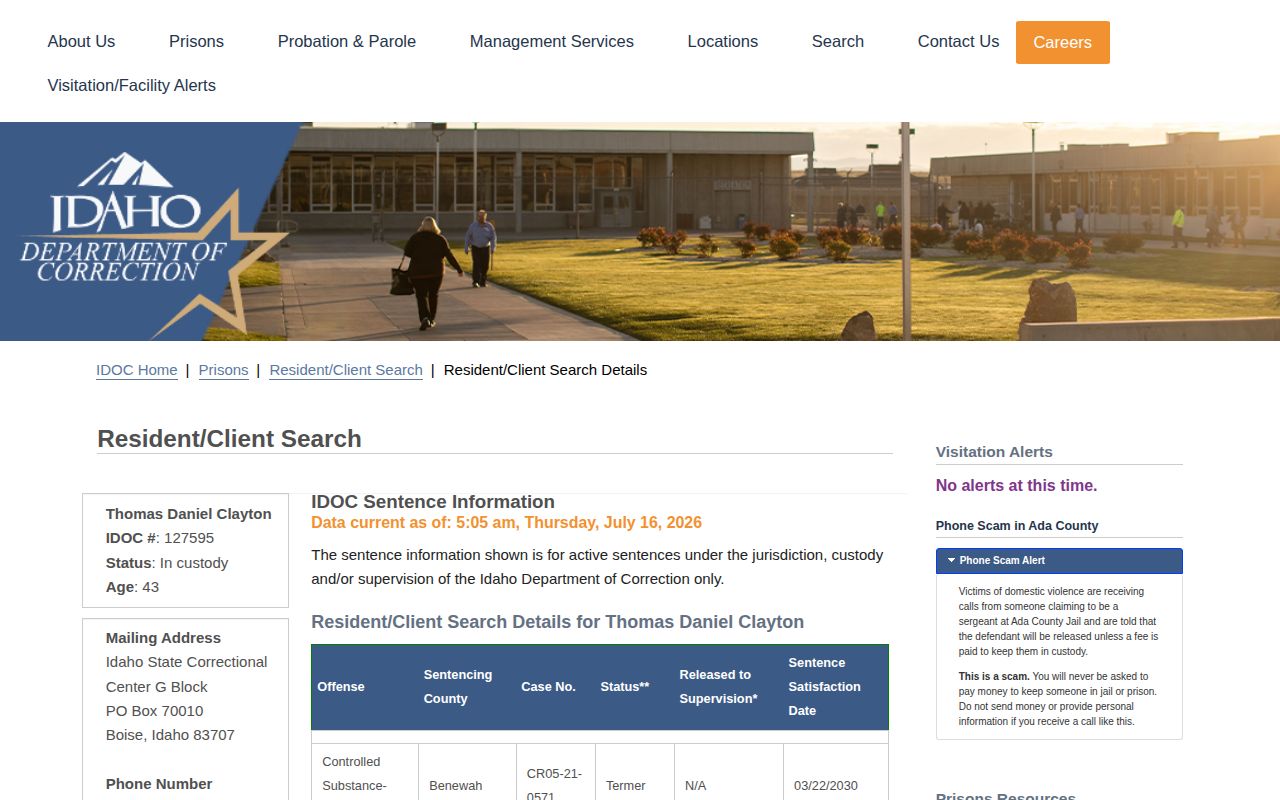
The image distinguishes Parole Eligibility Date from Sentence Satisfaction Date, neither of which should be renamed as an actual release timestamp.
When the web result is unclear, use the IDOC records portal to request a sentence calculation or release-to-supervision transaction if maintained and disclosable. Ask for date history and corrections instead of asking staff to create a new prediction.
Ada Jail Release Date Limits
A person held before trial has no sentence-based projected date. Release may depend on a bond payment, dismissal, court order, or later disposition. Bail eligibility and amount can appear on the ACSO roster, but a judge may order release and some charges may not be bailable. A warrant or hold in another matter can prevent departure after the local issue changes.
For a sentenced county inmate, the judgment and the jail's maintained calculation are the right sources. Request the booking and stay record, current-status and release entry, effective time, authority or disposition, and treatment of each hold or detainer. The Ada Current Arrests page cannot supply this calculation. It is keyed to arrest time and has no exact release date, release reason, or sentence endpoint.
Call ACSO at 208-577-3000 for present custody. For a durable record, use the ACSO public-record request or its online form. Provide the full name and birth date, booking date, JID or booking number, and case number when known. A roster disappearance can mean release, transfer, court movement, or a delayed update.
Note: A court order authorizes action, but the jail transaction is the stronger record of when staff completed release or transfer processing.
Idaho Fixed-Term Release Rules
Idaho Code §19-2513 requires a unified felony sentence. The court sets a fixed, or determinate, period and may add an indeterminate portion. The fixed term must ordinarily be served before parole consideration begins. “Indeterminate” means the later portion during which parole can be considered, not a promise that parole will be granted.
The Parole Eligibility Date generally marks the start of the indeterminate part. With multiple sentences, the Commission FAQ says the latest applicable begin date controls. Eligibility creates a chance for Commission review. Idaho Code §20-223 gives the Commission discretion, with no right or presumption of parole. Fixed-life, life-without-parole, and special statutory routes require case-specific review.
- Fixed term
- The determinate prison portion that must ordinarily be served.
- Indeterminate term
- The later sentence portion during which parole may be considered.
- Detainer
- A request or legal basis for another authority to hold or receive the person.
- Sentence satisfaction
- The calculated endpoint of the sentence record, subject to lawful changes.
The judgment controls sentence structure. Do not count forward from a booking date without accounting for judicial credit, concurrent or consecutive terms, amendments, and other cases. IDOC's official calculation and the filed judgment are stronger than an informal arithmetic estimate.
No Ada Eighty-Five Percent Formula
Idaho has no ordinary 85 percent rule, routine 15 percent credit, or standard behavior-based good-time subtraction for the fixed felony term. This is the distinctive feature of Ada County projected release research. Importing a formula from another state will often produce an incorrect date.
Idaho Code §20-101D provides an extraordinary, discretionary meritorious-service reduction. The statute addresses rare acts such as life-risking heroism, saving life or preventing major property loss during a riot, or preventing an escape. It is not routine credit for ordinary conduct, and an award can be withdrawn.
Medical parole is another special route and should not be folded into ordinary date math. The same is true for a court amendment. If a rare exception applies, cite the actual order or agency record rather than estimating its effect from a summary.
Ada Tentative Parole Dates
The Commission hearing schedule proves that a hearing was planned. The later Notice of Action hub can show a decision, next hearing, and Tentative Parole Date. Outcomes vary, including a grant, deferral, modification, revocation, or passage to full term. A hearing alone is not a release record.
A granted tentative date remains contingent. Commission material identifies programming, an approved parole plan or replacement plan, transportation arrangements, completed paperwork, and a signed parole contract as prerequisites. The decisions hub says no one will be released before the displayed tentative date, but that does not make departure automatic on that date.
The Commission decisions page below illustrates where Ada County projected parole evidence is published.
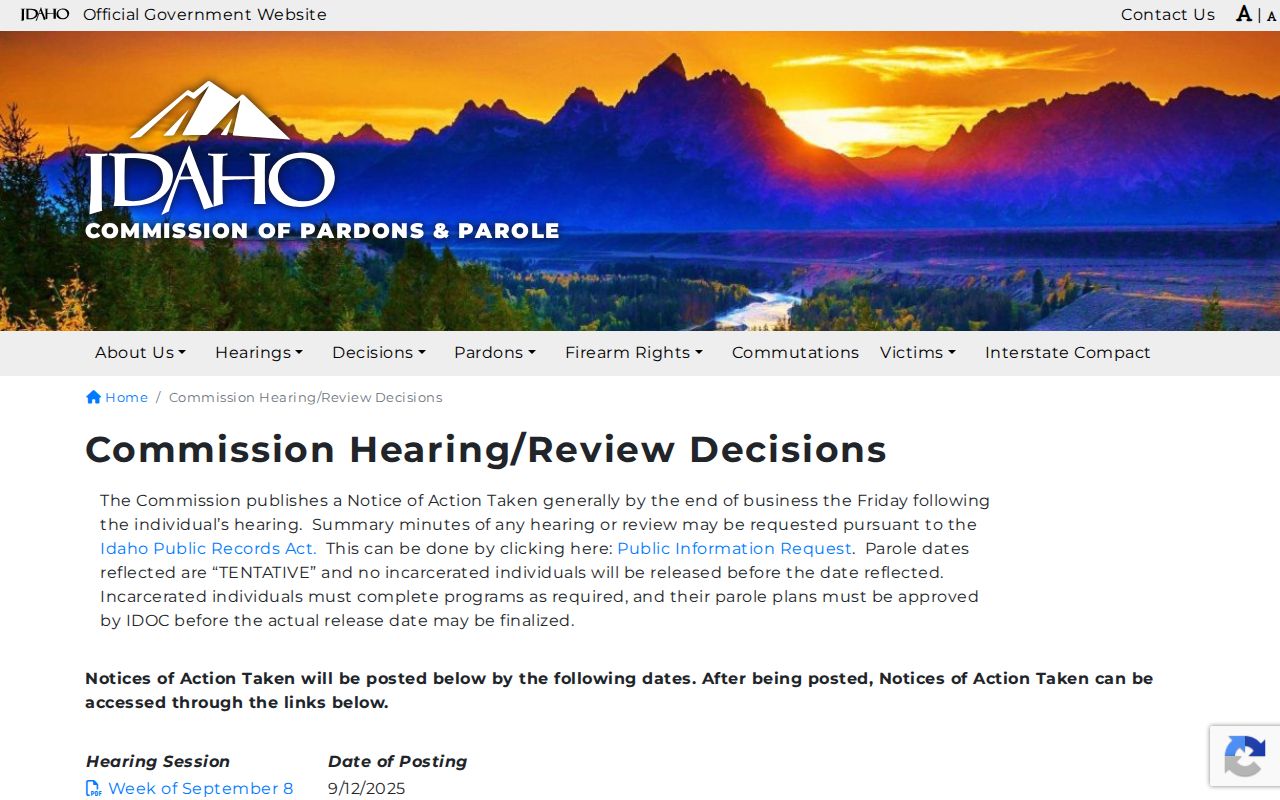
After reading the action, recheck IDOC for Released to Supervision and Current Physical Location to confirm whether the planned transition occurred.
The Ada County VINELink Inmate Search can provide a release or transfer alert, but the IDOC update and underlying transaction remain stronger proof.
What Changes Ada Release Dates
A published date can change for legal, sentence, custody, program, or data reasons. The right response is to locate the new source event, not silently choose the earlier or later date. Compare timestamps and the scope of each record.
| Change | Possible effect | Best source |
|---|---|---|
| Concurrent or consecutive terms | Changes which term controls | Judgment and IDOC calculation |
| Judicial credit or amendment | Recalculates sentence dates | Filed order and corrected IDOC record |
| New case, warrant, hold, or detainer | Delays community departure or changes custodian | Court, jail, and accepting agency |
| Parole grant, denial, or deferral | Creates, removes, or moves a tentative date | Commission Notice of Action |
| Program or parole-plan issue | Prevents planned transition | Commission and IDOC update |
| Violation, absconding, or revocation | May add time or move the endpoint | Commission, court, and IDOC |
| Data correction | Changes a public field without a new legal event | Source-agency correction record |
Current Physical Location is crucial. An IDOC client marked “In community” can show Ada County Jail after a new arrest. A prison-to-reentry-center move can remain an IDOC custodial placement. A county-to-IDOC transfer is continued custody, not a release into the community.
For conflicting records, prioritize the source closest to the event. The jail transaction is stronger than roster absence. An updated IDOC detail is stronger than an old tentative date. A formal Discharged entry and Gold Seal are stronger evidence of final IDOC completion than an earlier Released to Supervision field.
Confirm Ada Actual Release
An actual release answer requires an operational record. For Ada County Jail, call ACSO and ask whether the person left for the community or transferred, the effective date and time, and the accepting authority. Request the release or transfer entry when documentary proof matters. For IDOC, look for Released to Supervision, a changed physical location, and later Discharged status when final jurisdiction is the question.
For parole, pair the Commission action with the IDOC update. For probation, pair IDOC supervision status with the court order. For federal custody, use BOP only for a federal sentenced person. Immigration custody requires ICE ODLS. A label that ends one agency's custody does not rule out another custodian or continuing supervision.
Keep a short audit trail: exact name and identifier, source URL, access time, date label, status, physical location, and agency contacted. That record makes later changes easier to explain. The full Ada County search and records-request sequence appears on the released inmates home page.
Note: Report “projected,” “eligible,” “tentative,” “released to supervision,” and “discharged” only when those words match the source record.