
Ada Parole and Probation Compared
The Idaho Department of Correction District 4 supervises both groups in Ada County. Probation is a sentence or condition imposed by a court. Parole is conditional release from an IDOC prison under the Idaho Commission of Pardons and Parole. Both may require reporting, approved residence, lawful conduct, and compliance with case-specific terms. Neither label should be guessed from a person being outside a prison.
Ada County Pretrial Services is different. It supervises some defendants released by a judge before final case disposition. That person may have reporting or monitoring terms but is not thereby on parole or post-conviction probation. The court record and operating agency identify the correct category.
| Point | Probation | Parole |
|---|---|---|
| Authority | Sentencing court | Idaho Commission of Pardons and Parole |
| Typical starting point | Court places the person under supervision | Person leaves prison under a parole contract |
| Main public trail | IDOC client detail plus court order | IDOC detail plus Commission action |
| Completion proof | Court and IDOC completion records | Dated discharge and formal Gold Seal record |
- Parole
- Conditional community release from prison before the sentence fully ends.
- Probation
- Court-ordered supervision that may be imposed instead of, or after, confinement.
- Discharge
- The end of IDOC jurisdiction, not merely the date a person left a facility.
- Absconder
- A supervised person alleged to have stopped reporting or left supervision without authority.
Verify Ada Post-Release Supervision
Start with the official IDOC Resident/Client Search. It includes people in prison, on parole, on court probation, and people who completed an IDOC sentence. Search by at least the first two surname letters or by at least three initial digits of an IDOC number. Match the name, birth year, and IDOC number before relying on the detail page.
- Open the IDOC search and identify the correct person by more than one field.
- Read the top-level Status exactly. “In community,” “In custody,” “Active Bench Warrant,” and “Discharged” mean different things.
- Check Current Physical Location. An “In community” client can still show Ada County Jail after a new detention.
- Record Released to Supervision, Sentence Satisfaction Date, district, officer, and office phone when shown.
- For parole, compare the Commission decision, then recheck IDOC for an actual status and location change.
The official community-supervision example shows why that extra step matters. The IDOC community detail can place top-level supervision status beside a current jail location. The state record also distinguishes Released to Supervision from Sentence Satisfaction Date. The first is a past placement event. The second is the calculated outside endpoint in the active sentence record.
The IDOC example below shows the Ada County supervision fields and their layout.
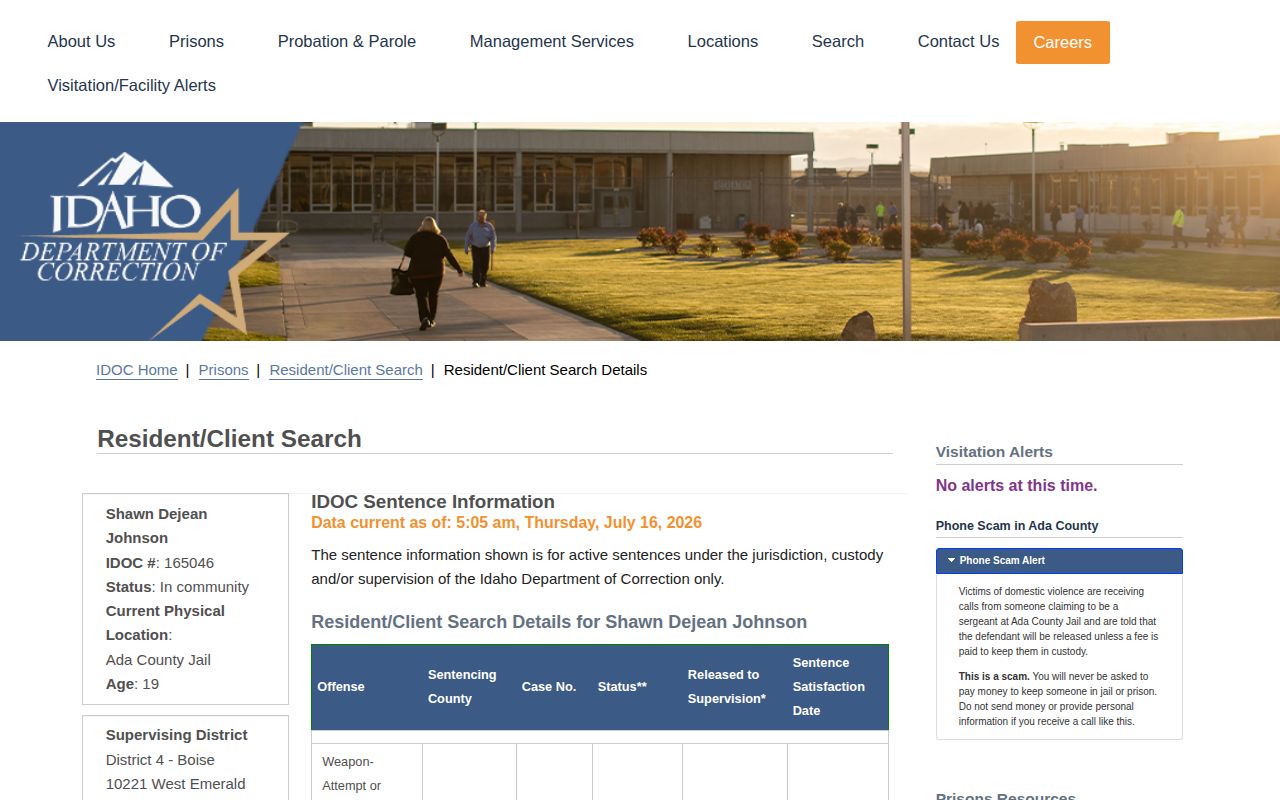
Its status, physical location, release-to-supervision date, and office data must be read as separate facts.
Ada Supervision Office Records
District 4 mirrors Idaho's Fourth Judicial District and covers Ada, Boise, Elmore, and Valley counties. The main Boise office is the best local starting point when an IDOC detail names District 4 but the assigned officer information is unclear or outdated. Satellite offices can place reporting closer to a person's approved area. Confirm the office shown on the live IDOC record before visiting.
IDOC Probation and Parole District 410221 W. Emerald Street
Boise, ID 83704
208-327-7008
Fax: 208-327-7351
District 4 also lists a Kuna office at 271 Ave D, 208-922-2908; an Eagle office at 1121 E. State St., Suite 104, 208-939-0410; a Meridian office at 1678 Woodsage, Suite 100; and the PSI Unit at 2161 Old Penitentiary Road, Boise, 208-334-3190. “PSI” means presentence investigation, a court-facing assessment function, not proof of parole.
The official District 4 page provides the current office directory.
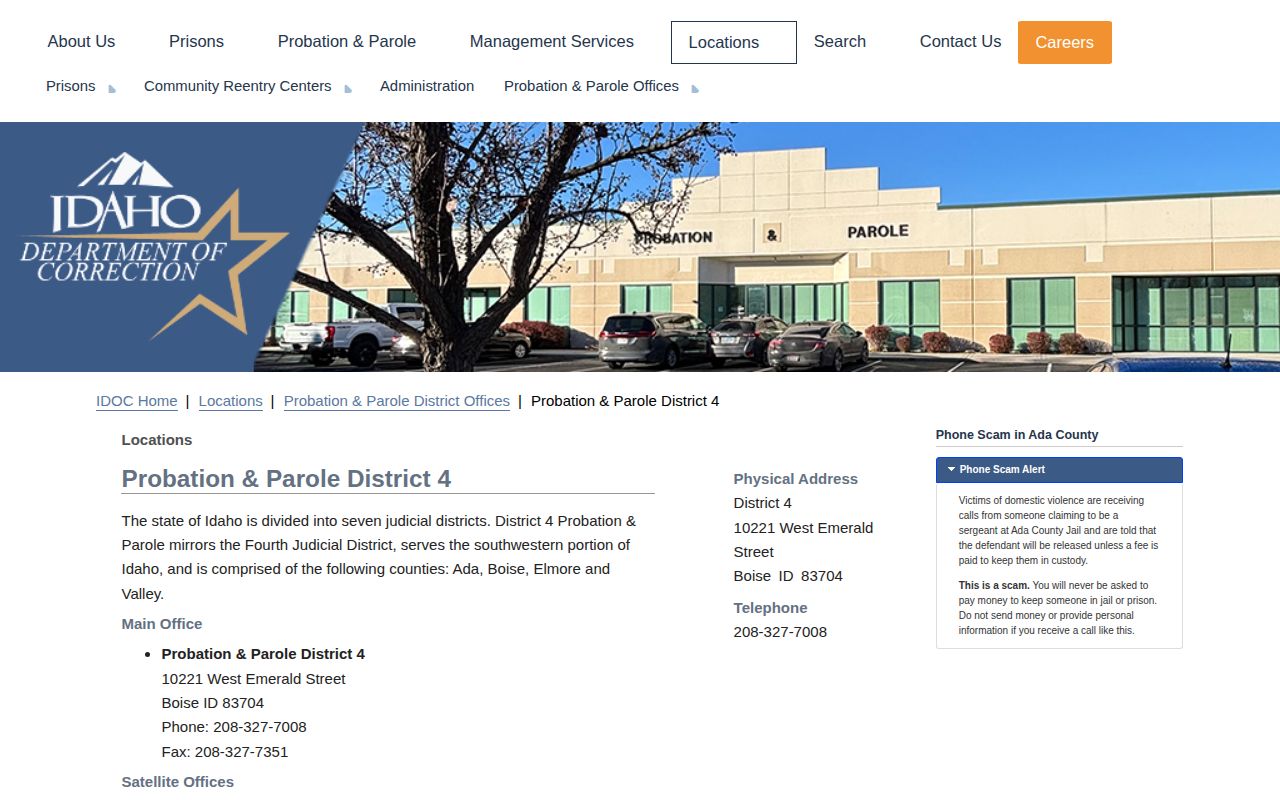
This office listing should be checked against the supervising office and phone shown on the individual IDOC detail.
Note: A district assignment identifies who administers supervision, while the court or Commission record explains the legal source of that supervision.
Ada Supervision Warrants and Violations
An Active Bench Warrant, fugitive notation, or absconder status points to unresolved enforcement. It is not a normal discharge. A person may remain under supervision even when their location is unknown. Confirm the warrant through IDOC, the relevant court record, and the agency named in the record rather than assuming the person completed supervision.
Parole responses vary with the conduct and Commission action. They can include a warning, detention, reinstatement, revocation, a new tentative date, more prison time, or passage to the full-term date. Under Idaho Code §20-229, the Commission describes a deadline framework for technical-violation hearings after service. Absconding time may also affect the full-term calculation under §20-1007, while revocation may forfeit time spent on parole. These are reasons an older release estimate can cease to match the current record.
Probation violations return to the sentencing court. Parole violations return to the Commission process. In either case, a current Ada jail booking can coexist with an IDOC community category until systems update or the legal response is resolved. Check the iCourt docket for filed orders, but use the custody agency to confirm physical detention or release.
Conditions come from the person's own order or parole contract. A general office page cannot establish which limits apply. Review the signed terms, later modifications, and the newest violation or reinstatement action. If an IDOC entry and court docket conflict, note both access times and ask the responsible office which event changed the status. That method avoids turning a stale warrant, cleared hold, or pending allegation into a final conclusion.
Ada Transitional Custody Settings
Ada County has an unusually dense set of transitional placements. The Ada County Community Transition Center is part of the county jail system. East Boise and Treasure Valley are IDOC community reentry centers, and South Idaho Correctional Institution runs IDOC's statewide pre-release program for many people nearing parole. Each setting can look like “release” while custody or a structured residential placement continues.
The operating agency controls the meaning. A resident of the county CTC remains within the ACSO jail route. A resident of an IDOC community reentry center remains in an IDOC placement. Pre-release programming at SICI remains incarceration until the authorized transition occurs. Use Current Physical Location, Released to Supervision, and later Discharged status rather than a facility name alone.
This distinction also prevents a transfer from being called community release. A move from Ada County Jail to an IDOC reception center, a prison, or a reentry center changes the custodian or location. It does not by itself end custody. The broader Ada County release search and records path is detailed on the home page.
Property After Ada Supervision Release
Property held by the Ada County Sheriff's Office as evidence or for safekeeping follows a different process from routine belongings returned during jail release. The official Property and Evidence instructions call for an appointment and photo identification. Depending on why the item is held, release may also require authorization from an officer, prosecutor, or judge.
Call 208-577-3050 before going to 7200 Barrister Drive. Check in at Records/Information in the Public Safety Building lobby. Published service hours are weekdays from 7:30 a.m. to 4:30 p.m. This channel should not be generalized to every item a person had at booking because normal jail property and evidence can have distinct release rules.
Supervision status does not itself authorize evidence release. If an item is tied to an open case, the custody record and property authorization answer different questions. Bring the requested identification and confirm which approval is still needed before travel.
Ada Supervision Discharge Records
Supervision ends through the authority that imposed or administered it. For parole, the Commission calls the formal completion notice a Gold Seal. It sends the record to the last supervision district, which forwards it to the person. Commission guidance warns that processing can take up to a month, so the paper may follow the legal end date.
An IDOC result marked “Discharged” with a date is strong public evidence that IDOC jurisdiction ended. It is not necessarily the prison gate date because discharge can follow months or years of community supervision. For documentary proof, request the final discharge or Gold Seal confirmation from IDOC or the Commission. Probation completion may also require the court docket or final court order, especially when the issue is whether a condition or case remains active.
IDOC keeps discharged people searchable, but satisfied conviction rows can disappear from the public detail. A sparse page is expected and does not erase prior supervision. When context is missing, request the basic record and identify the IDOC number, discharge date, supervising district, and case. Those details help staff locate the right record without relying on a name alone.
Note: Preserve each agency's date label because Released to Supervision, Sentence Satisfaction Date, Tentative Parole Date, and Discharged describe different events.