
Ada County Three-Day Release Trace
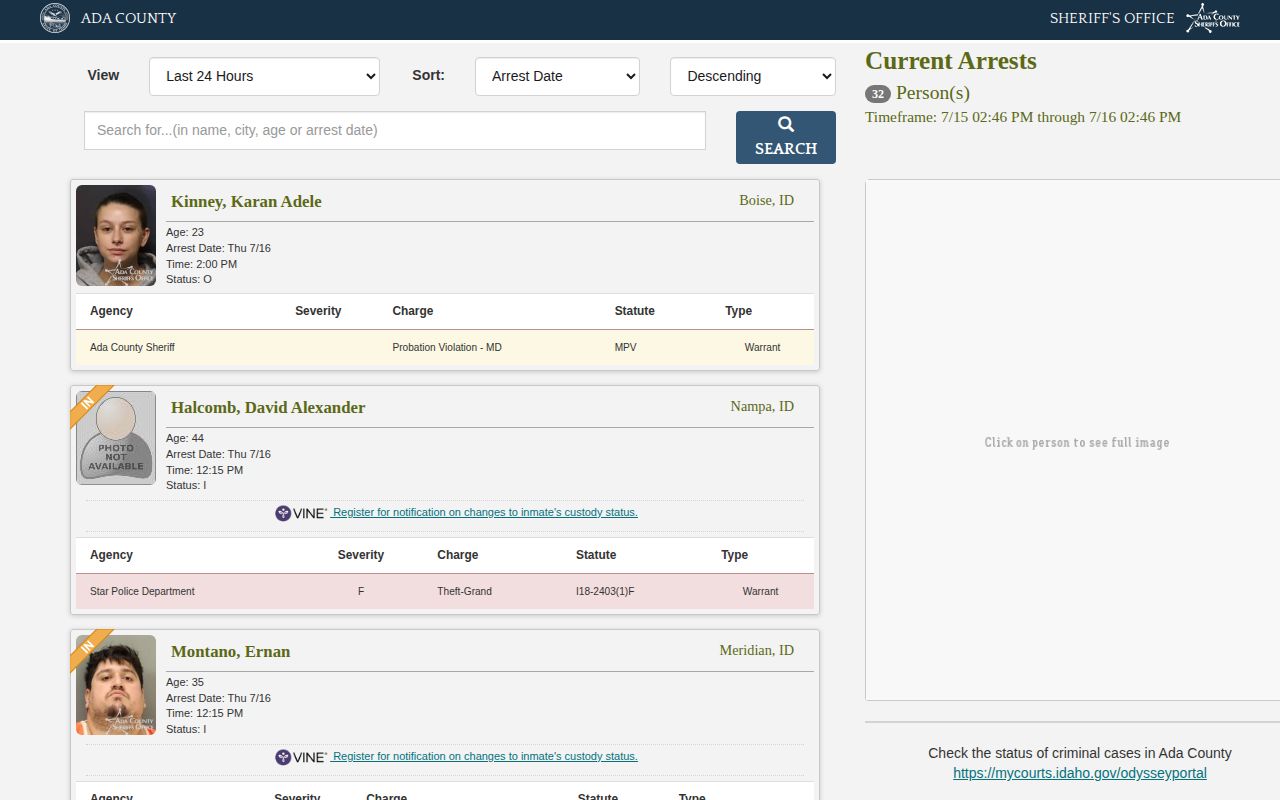
The Ada County Sheriff's Office Current Arrests service offers Last 4 Hours, Last 24 Hours, and Last 5 Days arrest windows. Those filters run from the arrest date. They do not run from the moment a person walked out of jail. Results can show a name, city, age, arrest date, agency, severity, charge, statute, type, status code, and booking photo. Observed records use the letters I and O. Their behavior supports an inference that O means the person is out of the Ada County Jail, but ACSO has not supplied a public legend defining either code.
That distinction matters. An O entry within the Last 24 Hours view shows a recent arrest that now appears under that status. It is not, by itself, a certified statement that release occurred within the same 24-hour period. Processing, an agency transfer, and the arrest-window clock can all change the meaning. Call Ada County Jail information at 208-577-3000 for present status. Ask whether the person left to the community or went to another custodian, and ask for the effective release or transfer time when available.
Build an Ada 72-Hour Window
Use several identifiers before drawing a conclusion. A common name or a booking photograph alone is not a sound match. Full name, date of birth, booking or jail identifier, arrest date, agency, and court case provide a stronger identity check. The fastest current-status path begins with the recent arrest view and then moves to the roster and the jail.
- Open Current Arrests and choose Last 24 Hours. Search or sort the results, then record the exact arrest date, displayed status, agency, charge, statute, and available identifier.
- Open the Ada County inmate roster and search by the first letters of the last name. Note the roster's posted timestamp.
- If the person is absent or the two pages conflict, call 208-577-3000. Give the full name and date of birth or booking number, not just a photo match.
- Ask whether the person remains housed, departed to the community, or transferred. A transfer to IDOC, ICE, another jail, or another agency is not community release.
- When documentary proof matters, request the booking, stay, and release or transfer transaction from ACSO.
A person may remain on the roster while paperwork is being processed. The opposite can happen too: a person may disappear because another authority accepted custody. Record the time each source was checked. The roster warns that it updates every 24 hours and directs users to telephone or in-person confirmation, so its absence is a lead rather than proof.
Ada 72-Hour Evidence Fields
The recent-arrest interface and the operational jail record answer different questions. The first is a convenient public snapshot. The second may document custody transactions in far more detail, subject to Idaho disclosure limits. Do not turn a field into a fact it was not designed to prove.
| Source or field | What it supports | Key limit |
|---|---|---|
| Arrest date and window | Whether the arrest falls in the selected recent period | Not a release timestamp |
| I or O status | A changing custody clue | No official public code legend was found |
| Agency and charge | Which event and authority the entry concerns | Does not resolve other holds |
| Current roster presence | Reported Ada jail custody placement at its stated update | Daily update and confirmation warning |
| Release or transfer entry | The operational transaction, if maintained and disclosed | Usually requires an ACSO request |
The ACSO prisoner-record policy supports asking for arrival date and time, arrest details, holds, detainers, and current-status or release entries. A detainer is a request by another authority to hold or transfer a person. It can prevent community departure even after one Ada case authorizes release. Public disclosure is not guaranteed for every internal field, but a narrow request gives the records unit a clear event to locate.
Why Ada Release Dates Matter
A three-day inquiry needs two dates: the arrest date used by Current Arrests and the actual release or transfer date being sought. The Last 5 Days filter can contain the relevant booking, but it does not isolate departures between two chosen times. An O record arrested four days ago could reflect a departure yesterday, while another O record may have left much earlier. The public display does not provide the exact release time or reason needed to sort those events.
Build the 72-hour range from a precise start and end time, then ask ACSO to confirm each event near those boundaries. Write down the page access time and roster timestamp. Record a court order's entry time separately because an order can precede jail processing. If another authority accepted custody, describe that event as a transfer rather than a community release.
A focused records request is the documentary route for a true three-day inquiry. Ask for existing release or transfer transaction records within the named interval, or identify a person and booking when a broad extract is unavailable. The office may apply lawful limits, redactions, processing time, and fees. It need not create a report that it does not maintain.
Ada Five-Day Arrest Trail
Ada's Last 5 Days Current Arrests view can preserve a useful clue after a name drops from the current roster. It may retain the booking image and an O status during that arrest-based window. This is the distinctive advantage of the five-day display: it can bridge the short period between an arrest listing and a formal record request. Yet it still is not a release list. A person arrested four days ago and released today may appear beside someone arrested and released much earlier.
Use the five-day view when a same-day search returns nothing or when the arrest may have occurred before the selected 24-hour window. Save the arrest date, agency, charge, and displayed status, then compare those facts with the roster and a telephone response. For a wider method, see Jail Releases: 72 Hours. That route also relies on the five-day source because ACSO does not provide a distinct 72-hour release feed.
The official Current Arrests interface shows the recent arrest filters and record layout.
Confirm Ada Release or Transfer
A current roster answers who ACSO reports as housed, while a release record answers how a specific jail stay ended. Someone who leaves on bond, by court order, after a county sentence, or into pretrial supervision may depart to the community. Someone handed to IDOC, ICE, a federal authority, or another jail has changed custodians. Both people can vanish from the Ada roster, but only the first category describes community departure.
| Result | Best next source |
|---|---|
| Still on Ada roster | ACSO phone confirmation and the pending case |
| Absent, reported community release | ACSO transaction plus iCourt order or disposition |
| Transferred to Idaho correction custody | IDOC Resident/Client Search and the accepting facility |
| Released with supervision | Pretrial Services or IDOC District 4, depending on authority |
| Custodian unclear | ACSO release/transfer record and receiving-agency confirmation |
The iCourt Portal may preserve the bond order, dismissal, judgment, sentence, or probation outcome after the web arrest trace expires. A court order gives legal authority; it may precede jail processing and does not prove the exit time. For state custody, use IDOC. For notice of a later movement or release, VINELink Inmate Search can provide rapid corroboration, but the originating agency remains the source to verify.
Request Ada Release Records
Use the ACSO public-record request route when the online trace has expired, status conflicts, or the exact release transaction is needed. Identify the person by full name and date of birth. Add the arrest or booking date, booking or jail number, court case, and every known alias. ACSO policy notes that merged arrest histories can use the oldest law-enforcement number, so extra identifiers help locate the correct history.
Ask for existing records, not a new analysis. A focused request can seek the Ada County Jail booking and stay record plus the transaction reflecting release or transfer. If maintained and disclosable, ask for effective date and time, authority or reason, receiving agency or destination, and disposition of each hold or detainer. Requesting the booking photograph separately can make the desired format clear. Idaho public-record rules allow processing time and lawful redactions, so a rapid telephone answer and a later record can serve different needs.
For an older event, pair the sheriff record with the Ada court case. If the jail stay led to an Idaho prison sentence or IDOC supervision, search the IDOC resident/client system too. A dated Discharged status means IDOC jurisdiction ended. It does not necessarily equal the earlier prison gate date. Each source should be used only for the custody system it controls.
Note: Write down source timestamps and exact labels so a daily roster lag is not mistaken for a conflicting release record.