
Ada County Release Status Explained
Release from Ada County custody is a change in legal or physical control, but it does not always mean a person walked into the community. The Ada County Sheriff's Office may release someone after bond, a court order, dismissal, credit for time served, or completion of a county sentence. It may also turn the person over to the Idaho Department of Correction, another county, the U.S. Marshals Service, or immigration authorities. That handoff removes the person from the Ada roster while custody continues elsewhere. The release entry must therefore be read with the destination, authority, and any unresolved hold.
Ada County has two distinct custody layers. ACSO runs the jail and Community Transition Center. IDOC operates prisons and community reentry centers in Boise and Kuna. County booking and release records belong to ACSO, while prison parole, release to supervision, and final discharge belong to IDOC and the Idaho Commission of Pardons and Parole. A court record can explain why release was authorized. VINE may announce a custody change. None of those sources should be silently substituted for another.
- Time served
- A court credits enough jail time to satisfy the term.
- Parole
- The Commission permits community supervision after part of a prison sentence.
- Probation
- The sentencing court orders supervision in the community.
- Discharge
- IDOC jurisdiction has ended, often after incarceration and supervision.
Ada County Inmate Release Routes
The label attached to an Ada County release determines the next reliable lookup. Bond and a court release usually return a person to the community, unless another hold remains. A transfer closes one facility's control but begins or continues another custodian's control. State parole is conditional and remains subject to IDOC supervision. Full discharge is different because the correctional sentence and supervision have ended.
| Route | Meaning | Best next source |
|---|---|---|
| Bond or court order | County jail authority to leave, subject to other holds | ACSO release record and iCourt order |
| Time served | County term credited or completed | Judgment plus ACSO departure entry |
| Transfer | Another agency accepted custody | Destination agency locator |
| Parole | Prison release into community supervision | IDOC Released to Supervision field |
| Discharge | IDOC jurisdiction ended | IDOC Discharged status and formal record |
Inside an Ada County Release Record
The public Current Arrests display is narrower than ACSO's underlying prisoner file. It shows the arrest, charges, photo, and a one-letter status, but it does not give an exact release time or define the reason. ACSO policy indicates that the maintained file can include identity, a merged identification number, arrival and arrest times, warrants, charges, court dates, holds, detainers, and the current status cover sheet. Disclosure may still be limited by privacy, an active investigation, protected victim or witness facts, security concerns, or a sealed case.
| Requested field | What it can establish |
|---|---|
| Name, birth date, JID or booking number | Which booking belongs to the person |
| Booking and arrival time | When the jail stay began |
| Release date and time | When ACSO control ended, if maintained and releasable |
| Authority or reason | Bond, court action, sentence end, or other basis |
| Destination agency | Whether another custodian accepted the person |
| Hold or detainer disposition | Whether another restraint affected departure |
| Booking photograph | The image created during booking, subject to review |
IDOC uses different fields. Parole Eligibility Date is an eligibility point, Sentence Satisfaction Date is the calculated outside endpoint, and Released to Supervision is the most recent placement on parole or probation. A public Discharged date means IDOC jurisdiction ended. It should not be relabeled as the day a prison gate opened.
Request Ada County Release Records
Use the ACSO public-record request page or its online form. A precise request reduces mistaken identity and avoids asking the office to guess which event matters. Supply the complete name and date of birth. Add the booking date, JID or booking number, and court case number when known.
- Ask for the booking and stay record tied to the exact person and event.
- Request the current-status or release transaction, effective date and time, and authority or reason if maintained.
- Request the destination or accepting agency and the disposition of each hold or detainer.
- Ask for the booking photograph separately in whatever form ACSO can disclose.
- Keep the written response and compare it with the relevant iCourt order.
7200 Barrister Drive
Boise, ID 83704
208-577-3012
ACSO states a usual response of three to ten business days and says charges may apply. Current Idaho Code §74-103 distinguishes Idaho residents from nonresidents: the usual resident decision period is three working days with a general extension to ten, while nonresident periods can be longer. Under §74-102, itemized charges and advance payment can apply in authorized cases. The Idaho Attorney General's guidance says Idaho residents receive the first two labor hours and 100 pages without charge before authorized fees begin.
Online visibility is not the same as retention. Ada's roster is current-only, and Current Arrests looks back by arrest date for no more than five days. iCourt and requested ACSO records are the longer paths. Sealing or shielding can remove court material from public view under Idaho Court Administrative Rule 32 and Idaho Code §67-3004. A missing public result does not prove that no arrest, booking, or release occurred.
Idaho Rules for Ada Release Records
The Idaho Public Records Act governs many ACSO, IDOC, and Commission records, subject to exemptions. Section 74-102 addresses inspection and copy fees. Section 74-103 controls response periods and written denials, while §74-115 provides a 180-day period to challenge a denial. Section 74-120 restricts use of public records to create mailing, electronic, or telephone lists. Court files follow ICAR 32 instead of the executive records act.
Idaho Code §20-601 requires a photograph and fingerprints at county booking. That rule proves a booking photo is created, not that it must stay online or be disclosed in all cases. The correct approach is to request the image from ACSO and accept the custodian's written exemption decision if a legal limit applies.
Ada County Bond Release Costs
Ada County's bond process is charge-based. The official jail page states that bond is paid with a $25 administrative fee for each charge, except when a judge groups charges under one case number and one fee applies. The roster displays whether bond is available and the amount. A posted bond still does not defeat an unrelated hold, so phone confirmation and the release transaction remain necessary.
Payment rules differ by method, and the official jail page should be checked before travel. The useful record is not merely a receipt. It is the jail entry showing that all release conditions were satisfied and whether ACSO released the person to the community or another authority.
Property After Ada County Release
Property handled during a routine release is not always the same as property held by ACSO as evidence or for safekeeping. The Property and Evidence Unit may require an appointment, photo identification, and authorization from an officer, prosecutor, or judge. Call 208-577-3050 and check in at 7200 Barrister Drive when that separate process applies.
Do not assume every personal item follows the evidence-unit route. Ask jail staff what was returned at release, then ask the evidence unit about only the property it controls. Written authorization can matter when a case or court order restricts release of an item.
Find Released Ada County Inmates
Begin with the agency that most likely held the person. A recent local arrest calls for ACSO tools. An Idaho felony prison term or supervision calls for IDOC. A federal sentence belongs in the BOP locator. Immigration detention belongs in ICE ODLS. The source must match the custodian.
- Open ACSO Current Arrests, select the 24-hour or five-day arrest view, and match the person carefully.
- Check the current inmate roster. If absent, call 208-577-3000 and ask whether the outcome was community release or transfer.
- Search iCourt for the Ada criminal case and read the filed order or judgment.
- Use IDOC when the person entered state correctional custody or community supervision.
- Use VINE for a timely custody-change notice, then confirm with the operating agency.
- Submit an ACSO or IDOC records request when the public pages do not preserve the needed event.
The Ada jail releases in 24 hours page explains the arrest-window shortcut. It is not a complete release feed, since an older booking released today may fall outside that view.
IDOC Search for Ada Releases
The IDOC Resident/Client Search covers incarcerated residents, people on probation or parole, and people who completed an IDOC sentence. It will not necessarily include someone who only bonded out of Ada County Jail. Search by at least the first two letters of the last name or the first three digits of an IDOC number, then match the birth year and full name.
| Field | How to read it |
|---|---|
| Status | May show In custody, In community, Active Bench Warrant, or Discharged with a date |
| Current Physical Location | Can reveal a new jail stay even when the broad status says In community |
| Released to Supervision | Most recent court or Commission placement on supervision |
| Parole Eligibility Date | Earliest consideration point, not a promised departure |
| Sentence Satisfaction Date | Calculated sentence endpoint, subject to change |
The official IDOC search screen shows the available search fields and daily-update warning.
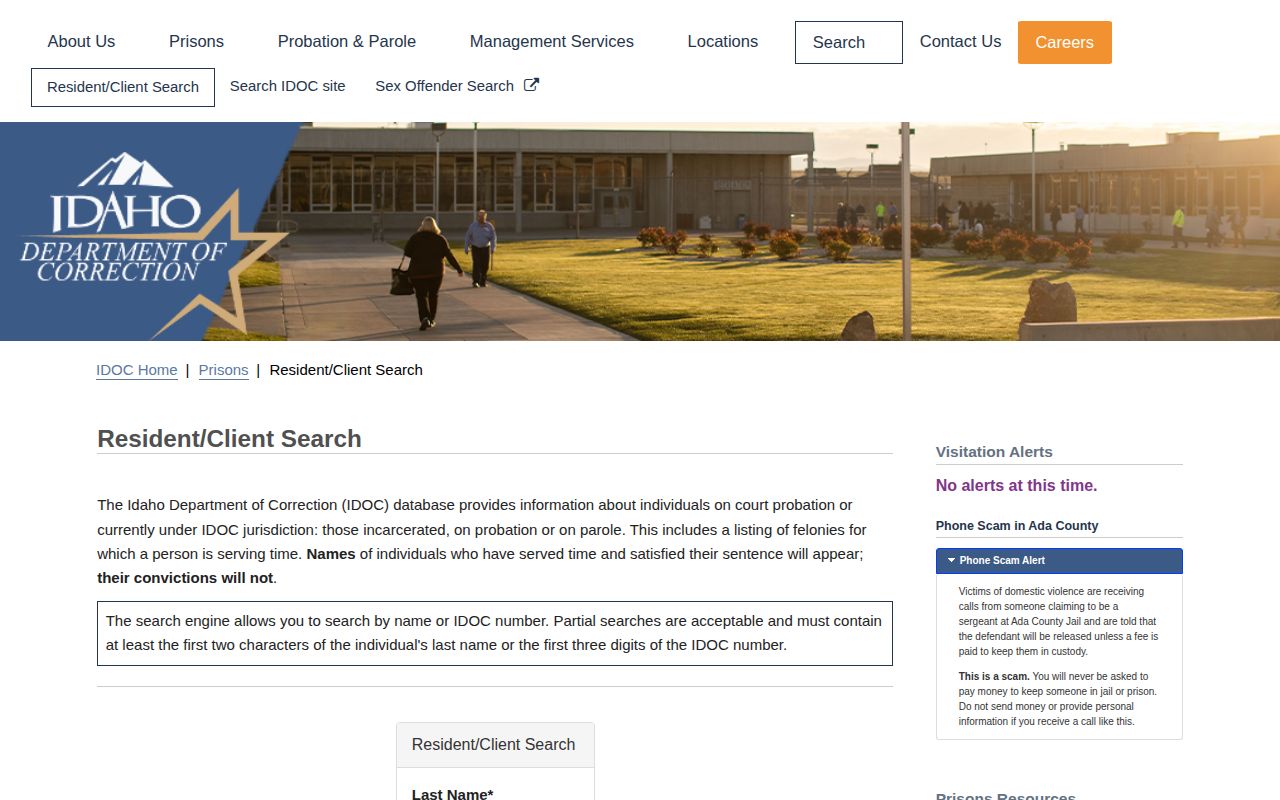
The screen is the correct state route only when IDOC had jurisdiction. Read each date by its agency label.
Ada County Recent Release Clues
ACSO does not publish a complete release-date feed. Current Arrests offers Last 4 Hours, Last 24 Hours, and Last 5 Days, but those windows are based on arrest date. Live review found records marked I and O. The I records linked to VINE while O records did not, which supports an in-versus-out inference, yet ACSO provides no public legend defining those letters.
An O record for a recent arrest can preserve the charge and photo after the person leaves the roster. It cannot prove the exact time, reason, or destination. Someone booked months earlier and released today will not appear in a five-day arrest window. Call ACSO and request the transaction for complete proof.
Ada County Post-Release Supervision
IDOC District 4 supervises parole and probation in Ada County. Probation remains under the sentencing court, while parole remains under the Commission. An IDOC result marked In community can show the district, officer, office phone, and Released to Supervision date. Always read Current Physical Location because community supervision can coexist with a new jail detention.
Ada also has transitional settings that can look like release. The county Community Transition Center, IDOC community reentry centers, and South Idaho Correctional Institution's pre-release program may involve work, treatment, or planning outside a conventional prison unit. The operating agency record decides whether the person remains in custody. The Ada probation and parole record path explains District 4 verification and final discharge.
Ada iCourt Preserves Release Authority
Ada County was an early iCourt launch county. The public docket can preserve a dismissal, bond order, sentence, time-served credit, probation order, or amended judgment after a jail roster item disappears. Search by name or case number, narrow the result to Ada County and the criminal case, and open the actual register of actions and filed order.
A court result establishes legal context, not the moment jail processing ended. Another hold can delay departure after an order, while a bond release can occur before the case ends. Pair iCourt with ACSO status, VINE, or the requested release transaction. Restricted, sealed, or not-yet-entered records also mean that no search result proves little.
Ada Release Alerts and Federal Records
Idaho VINE connects participating jail booking systems and IDOC. Search a named person, match the agency and identifying details, then register for phone, text, or email notice while the person remains in custody. A phone registration uses a four-digit PIN and requires confirmation. VINE is free and useful for timing, but it is not a certified record and delivery can lag.
Use the BOP Inmate Locator for federal sentences. Released or Not in BOP Custody does not rule out supervision or another custodian. ICE ODLS covers current detention and releases within 60 days. The U.S. Marshals Service has no comparable public release-name locator, so a federal docket, holding agency, or records request is needed for federal pretrial custody.
Ada Release Versus Current Custody
Choose a system by both agency and time. A live roster answers who is housed now. A release record preserves how one jail stay ended. State and federal locators cover only their own correctional systems.
| Source | Still in custody | After release |
|---|---|---|
| ACSO roster | Current Ada jail housing | Name normally disappears |
| ACSO release record | May show active stay | Departure transaction, authority, and destination if releasable |
| IDOC search | In custody and physical location | In community, Released to Supervision, or Discharged |
| iCourt | Orders and case status | Judicial outcome, not physical departure time |
| BOP locator | Federal facility or status | Federal release date or not-in-custody status |
Ada County Release Facilities
Ada County Jail and its Community Transition Center use ACSO records. The six state prisons and two community reentry centers use IDOC's Resident/Client Search and records portal. A move among those IDOC locations is not community release. Confirm a Released to Supervision or Discharged status and compare it with Commission action when parole applies.
- Ada County Jail, the county booking and release hub
- Ada County Community Transition Center, an ACSO jail component
- Idaho Maximum Security Institution
- Idaho State Correctional Center
- Idaho State Correctional Institution
- Mountain View Transformation Center
- South Boise Women's Correctional Center
South Idaho Correctional Institution runs a major pre-release program. East Boise and Treasure Valley Community Reentry Centers are structured IDOC placements. They remain correctional settings until the official record shows the authorized transition.
Ada County Jail Release History
Ada County's jail scale changed sharply without changing the need to verify each release. The official jail history says the 1977 design held 160 jail beds and 32 work-release spaces. ACSO now reports 1,116 beds, while the Community Transition Center has 100 places. Those figures describe capacity, not the number of releases or the odds that a named person has left custody.
A 2023 proposal sought bond funding for a 294-bed expansion and narrowly missed the required supermajority. That local history helps explain why Ada has both a large jail operation and several transition settings. It does not turn a roster count into a release count. The named person's ACSO transaction, court authority, and destination remain the proof.